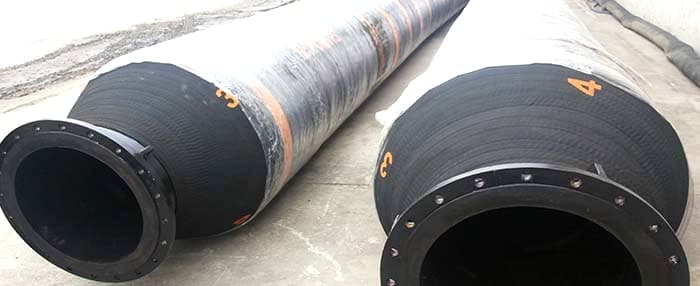
Dredging & Discharge Hoses
Hard-wall rubber hoses for abrasive dredging slurry & sand
Overview
A dredge rubber hose carries abrasive sand-and-water slurry between a cutter-suction dredger, its floating line and the discharge point. It is a hard-wall rubber hose built to survive continuous pumping of highly abrasive mixtures with increased reinforcement against puncture, cutting and abrasion.
Each end is terminated with a steel-laminated rubber flange (typically ANSI B16.5 Class 150) that anchors into the body of the hose, so it can be bolted straight into a dredging line.
How it works
The hose is a three-layer build. A thick abrasion-resistant inner lining — 20 mm or more — takes the wear from the pumped solids and carries a coloured wear-indicator layer, so operators can see when the liner is nearing the end of its life. A ceramic-lined option is available where wear is severe.
Around the liner, two or more layers of textile cord or steel-wire reinforcement give the hose its tensile strength and resistance to kinking, and an outer rubber cover resists puncture, weather, UV and ozone.
Why it's used
- Thick abrasion-resistant inner wear liner
- Built-in coloured wear-indicator layer
- Textile-cord or steel-wire reinforcement
- Floating, self-floating or subline builds
- Optional ceramic lining for extreme wear
Hoses are supplied in standard lengths (for example 2 m and 6 m) and bore sizes to suit the line, and are rated for the slurry density, solids size and working pressure of the job. Flanges, bolts, washers and gaskets are supplied ready to install.
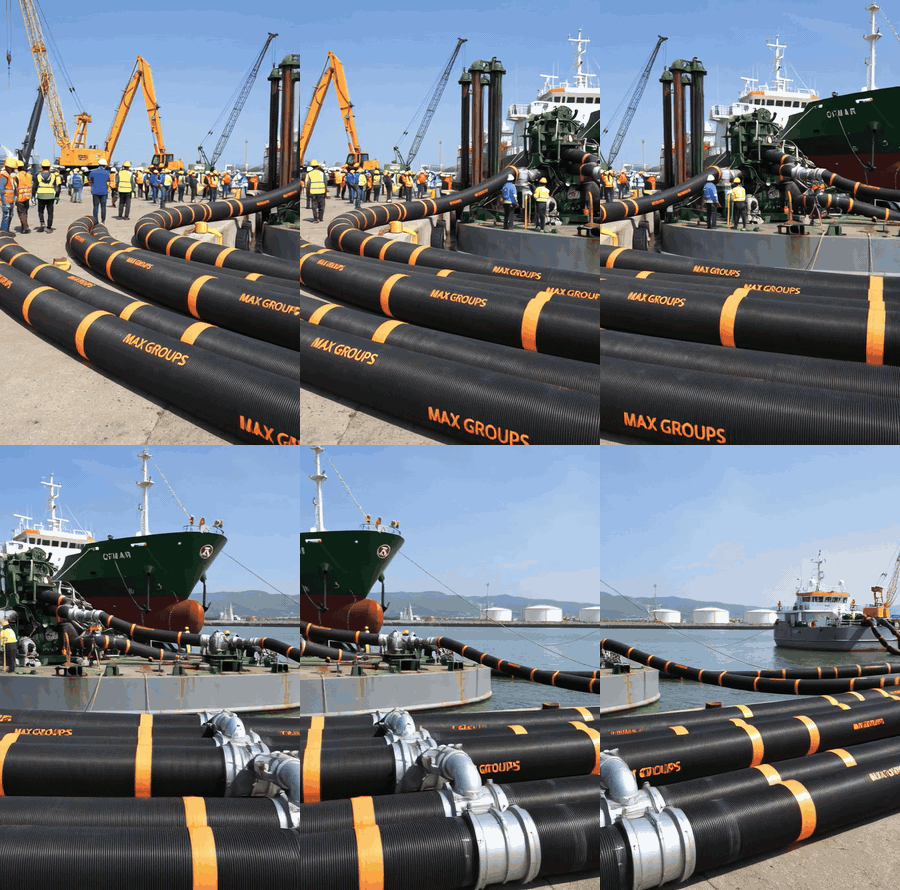
An AI-reimagined dredging line — abrasive sand and slurry, pumped hose after hose.
Typical applications
- Cutter-suction dredger discharge
- Sand & slurry transfer
- Land reclamation
- Marine terminal fluid transfer
Need this sized for a vessel?
Send the vessel data and get the relevant specification and standards back.
Start an enquiryQuestions & answers
How does Dredging & Discharge Hoses work?
The hose is a three-layer build. A thick abrasion-resistant inner lining — 20 mm or more — takes the wear from the pumped solids and carries a coloured wear-indicator layer, so operators can see when the liner is nearing the end of its life. A ceramic-lined option is available where wear is severe. Around the liner, two or more layers of textile cord or steel-wire reinforcement give the hose its tensile strength and resistance to kinking, and an outer rubber cover resists puncture, weather, UV and ozone.
Where are Dredging & Discharge Hoses used?
Cutter-suction dredger discharge, Sand & slurry transfer, Land reclamation, Marine terminal fluid transfer
Which standards apply to Dredging & Discharge Hoses?
Manufactured and evaluated to CCS, Bureau Veritas
More equipment
Imagery & technical data referenced from max-groups.com