Solid Rubber Fenders
Cell, cone, arch, element & cylindrical fenders evaluated to PIANC 2002
Overview
Solid rubber fenders are the workhorses of quay and jetty protection. Unlike air- or foam-filled fenders they are moulded from solid rubber, so they absorb berthing energy purely by deforming — reliable, low-maintenance and cost-effective for protecting both the structure and the vessel from heavy impacts.
The family covers several shapes: cell (SCN) and cone (SCK) units carry a steel frontal panel for large-vessel quays; arch (V-type), element, square, cylindrical and D-type units suit tugs, workboats and general berths. A cylindrical fender is round and absorbs more energy for larger vessels, while a D-type is flatter and more compact for tighter spaces.
How it works
On contact the rubber body compresses and converts the vessel's kinetic energy into controlled deformation. Performance is characterised by the reaction-force and energy-absorption curves published under PIANC 2002 — modern cell and cone designs give high energy absorption at low reaction force, spreading the load evenly for better durability.
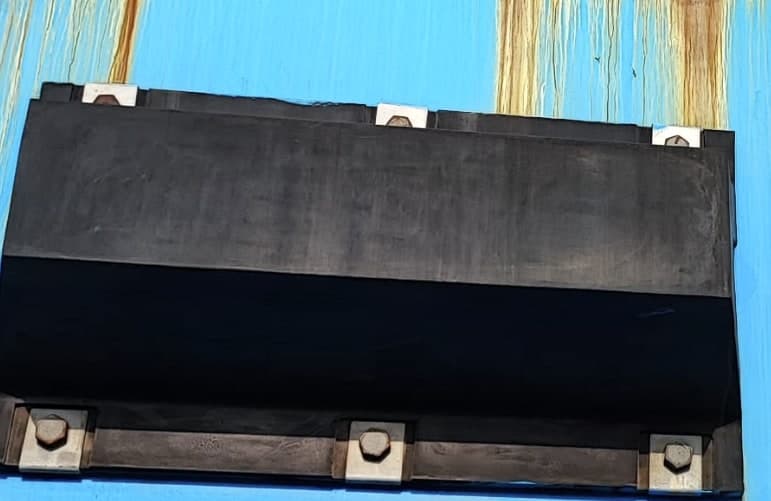
A UHMW-PE (ultra-high-molecular-weight polyethylene) face pad is often bolted to the steel front panel. Its low friction and high wear resistance reduce the shearing force on the fender and extend service life at busy berths.
Why it's used
- High energy absorption at low reaction force
- Uniform force distribution for better durability
- Solid rubber — no air or foam to maintain
- UHMW-PE face pad reduces friction & shear
- Wide shape range for any berth
Fender shape and rubber grade are selected from the berth's design berthing energy and allowable hull pressure. A UHMW-PE face pad, available in several colours, can be added to any panel type to lower the coefficient of friction and shearing force.
Typical applications
- Container & bulk terminal quays
- Dolphins & jetty structures
- Passenger & Ro-Ro terminals
- Tug & workboat fendering
Need this sized for a vessel?
Send the vessel data and get the relevant specification and standards back.
Start an enquiryQuestions & answers
How does Solid Rubber Fenders work?
On contact the rubber body compresses and converts the vessel's kinetic energy into controlled deformation. Performance is characterised by the reaction-force and energy-absorption curves published under PIANC 2002 — modern cell and cone designs give high energy absorption at low reaction force, spreading the load evenly for better durability. A UHMW-PE (ultra-high-molecular-weight polyethylene) face pad is often bolted to the steel front panel. Its low friction and high wear resistance reduce the shearing force on the fender and extend service life at busy berths.
Where are Solid Rubber Fenders used?
Container & bulk terminal quays, Dolphins & jetty structures, Passenger & Ro-Ro terminals, Tug & workboat fendering
Which standards apply to Solid Rubber Fenders?
Manufactured and evaluated to PIANC 2002, CCS, Bureau Veritas
More equipment
Imagery & technical data referenced from max-groups.com